

Solar panels for communities: reduce fees by sharing solar energy

Approval by the owners' meeting
You only need the approval of one third of the owners representing one third of the participation shares (Spanish Horizontal Property Law art. 17).
SolarTradex prepares all the documentation needed to present to the community meeting:
- Technical and financial proposal.
- Estimated savings per home.
- Proposed distribution coefficients.
- Timeline and full process.
Energy sharing between neighbours
Participants agree on distribution coefficients that determine what percentage of production corresponds to each supply.
SolarTradex proposes a tailored distribution after analysing:
- Consumption of each home or business unit.
- Common area consumption.
- Available roof surface.
- Legal collective self-consumption model.
Turnkey solar panel installation
We manage all the main phases of the project so the community doesn't have to coordinate different companies:
- Consumption and roof study.
- Design and sizing.
- Energy sharing proposal.
- Engineering and installation.
- Legalisation and commissioning.
- Surplus management.
- Monitoring and maintenance.
We also prepare a clear proposal to present to the owners' meeting.
Solar energy shared between neighbours
A single photovoltaic installation can power the common areas and share part of the energy between the participating homes or premises.
It can be used to reduce consumption of:
- Lifts and common area lighting.
- Garage, pool and pumps.
- Participating private homes.
- Commercial premises in the building.
- Electric vehicle chargers. At SolarTradex we analyse consumption and propose a distribution tailored to the community's needs.
How we install solar panels in your community
1. Consumption study and roof analysis
We analyse the bills from common areas and participating owners, together with the surface and structure of the available roof.
2. Energy distribution design and community proposal
We prepare a technical and financial proposal with distribution coefficients tailored to each supply, ready to present at the community meeting.
3. Engineering, installation and legalisation
We execute with our own team without subcontracting and manage all the paperwork: municipal permits, legalisation with the distribution company and collective self-consumption activation.
4. Monitoring and maintenance
Performance tracking system and maintenance plans to protect the investment and ensure the expected savings throughout the system's lifespan.
Real cases of collective self-consumption
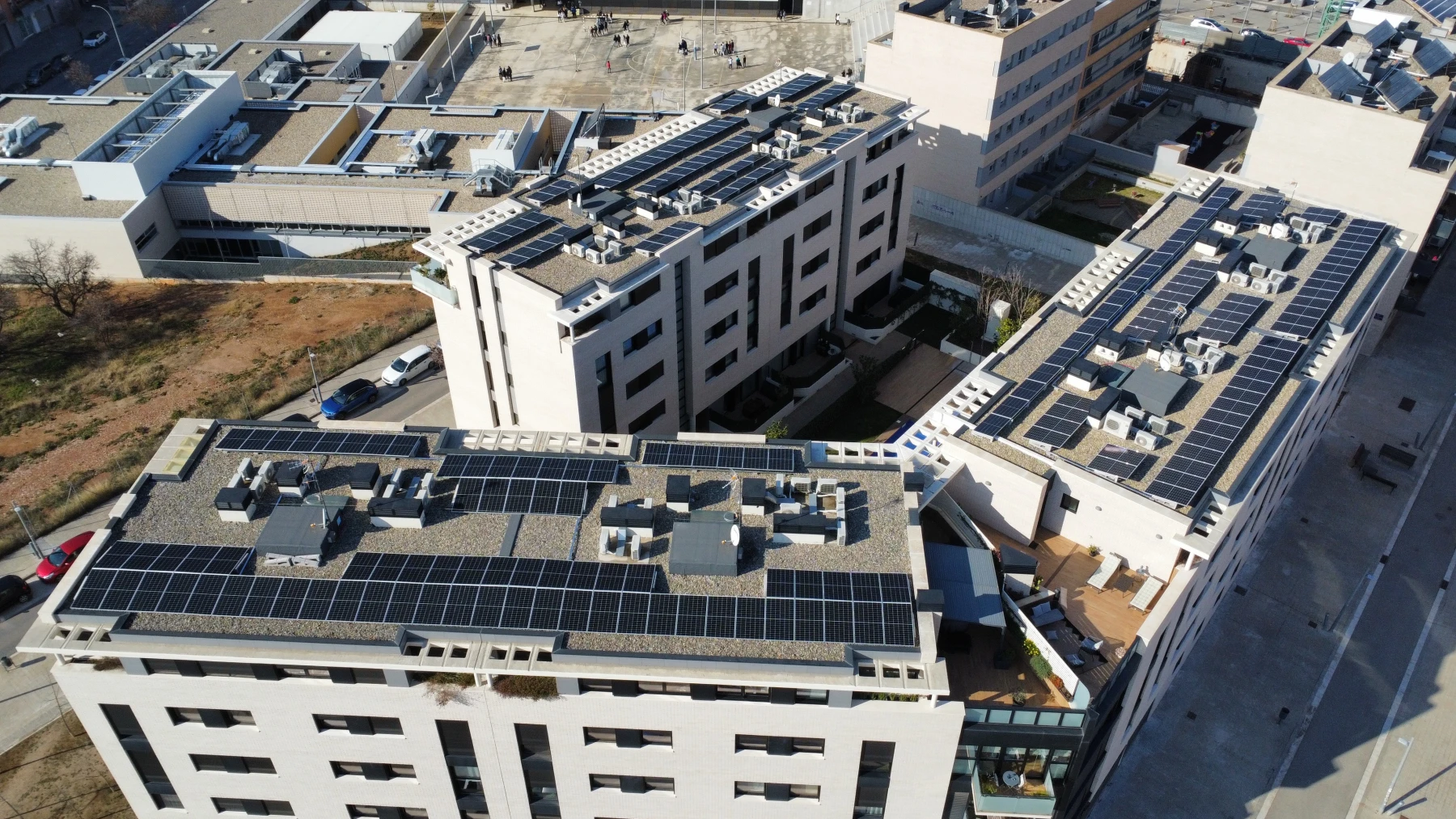
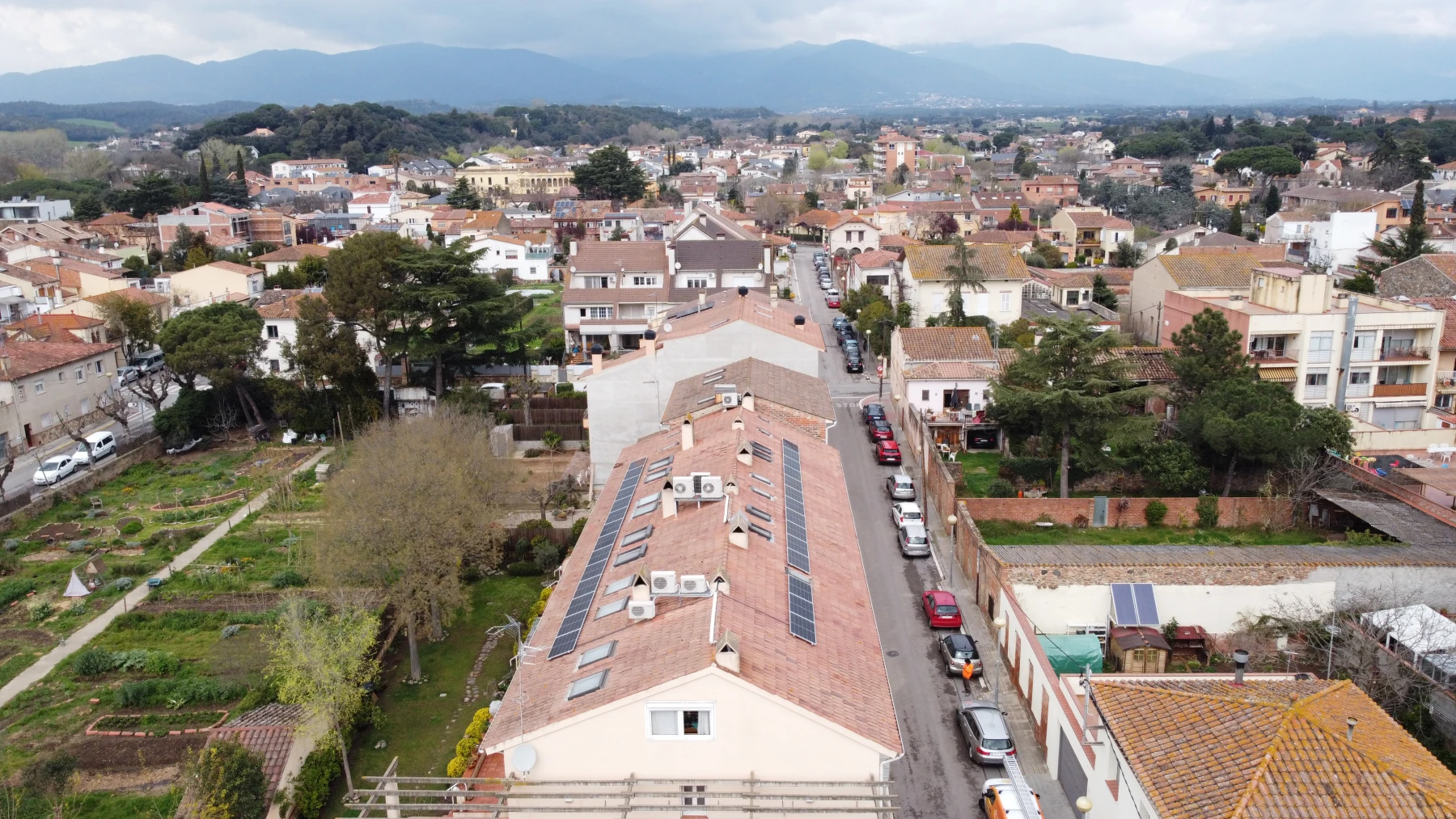
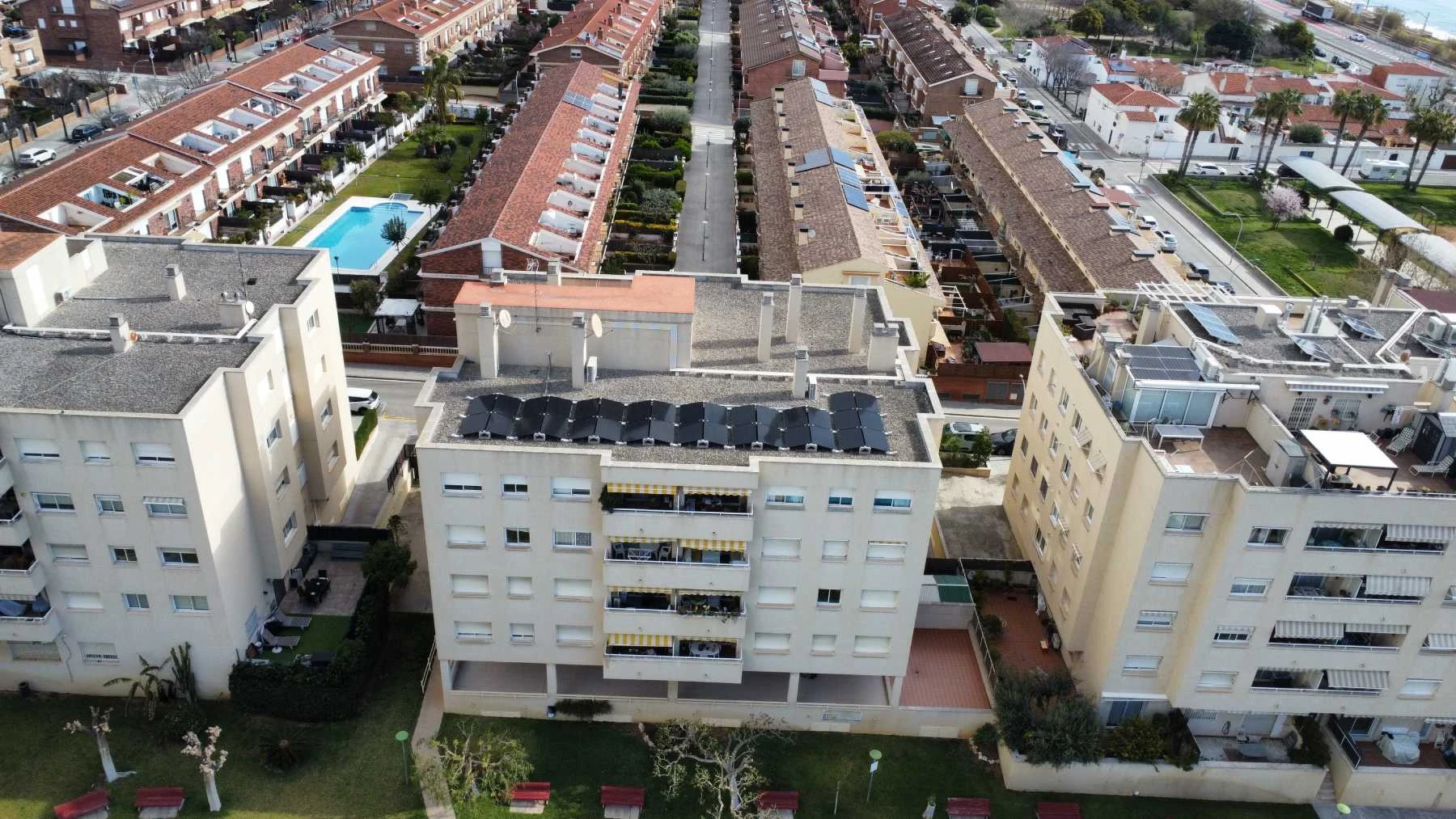
Real cases of homeowner communities that are already sharing solar energy in Catalonia and the Balearic Islands. We have developed collective self-consumption projects from small communities of 6-8 homes to large buildings with 80 neighbours. Discover in each project the installed power, the number of panels and the particularities of each community.
Drastically reduce the cost of your installation by combining the current grants available in Catalonia and the Balearic Islands. At SolarTradex we take care of the study, paperwork and complete management so you get the maximum tax benefit available.
- Personal income tax deduction up to 60% (RDL 7/2026): the new Royal Decree-Law extends deductions for homes: up to 20% for renewable self-consumption and up to 60% for energy renovation (combining photovoltaic + heat pump).
- Municipal IBI and ICIO reductions: most municipalities in Catalonia and the Balearic Islands apply reductions of up to 50% on IBI for 3-5 years and up to 95% on ICIO for projects integrating renewables.
- FACTOR 2026 programme · exclusive to the Balearic Islands: Balearic regional call with specific grants for photovoltaic, heat pumps, batteries and charging points.
Why choose SolarTradex
✅ In-house technical team (more than 50 people)
✅ Specialised in-house engineering (50% of the team are engineers/economists)
✅ Experience in the solar sector since 2010
✅ Full project management: no subcontracting, no intermediaries
✅ Regular trainers at the Association of Industrial Engineers of Barcelona and Lleida

Frequently asked questions about collective self-consumption

How is the energy shared?

Participants agree on sharing coefficients that determine what part of the production corresponds to each supply point.
Can it be used for the lift and common areas?
Yes. The energy can be used for lighting, lifts, garage, pool and other community services.
What happens with the surplus?
The energy not consumed can be compensated on the bills when the installation meets the requirements of the chosen modality.
Does SolarTradex handle engineering and legalisation?
Yes. We handle the engineering, installation, legalisation and all the procedures needed to activate collective self-consumption.
How does participation and community approval work?
Not all neighbours are required to take part. The installation can supply only the common consumption, the interested owners or combine both options.
Community approval is required, but with low thresholds: in Catalonia, simple majority at the meeting; in the Balearic Islands, one third of the owners (art. 17.2 LPH). SolarTradex prepares the documentation for the meeting.
